
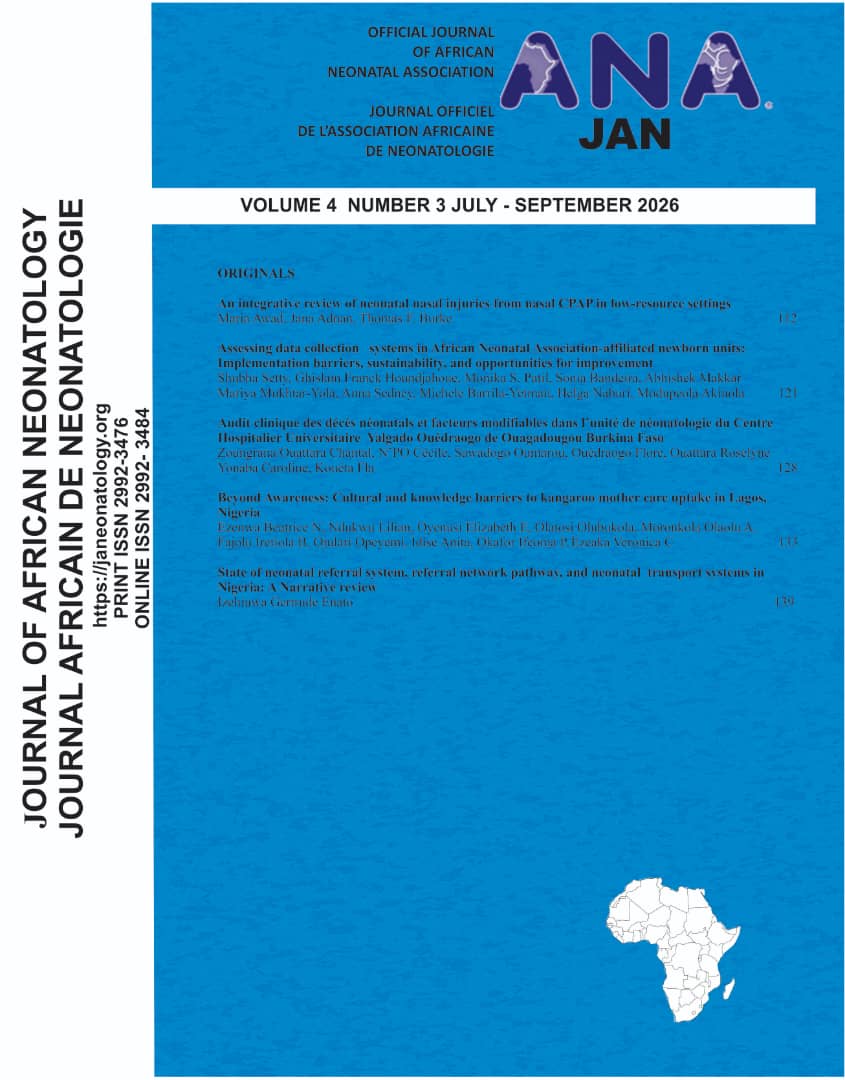
Audit clinique des décès néonatals et facteurs modifiables dans l’unité de néonatologie du Centre Hospitalier Universitaire Yalgado Ouédraogo de Ouagadougou Burkina Faso
Mots-clés :
Audit, neonatal deaths, modifiable factors, CHU-YORésumé
Introduction: Neonatal mortality remains a major public health issue in resource-limited countries. In 2022, approximately 2.3 million newborns died, mainly in sub-Saharan Africa. Auditing neonatal deaths is an essential strategy recommended by the World Health Organization to improve the quality of care and reduce preventable deaths. The objective of the study was to analyze the causes of neonatal deaths and identify modifiable factors in the Neonatology Department of the Yalgado Ouédraogo University Hospital Center.
Methodology: It was a descriptive cross-sectional study of neonatal deaths that occurred between January 1 and December 31, 2024, in the department, excluding those that occurred before any treatment was provided. Medical records were used as data sources. The analysis was conducted in accordance with World Health Organization recommendations for auditing neonatal deaths.
Results: Intra-hospital neonatal mortality was 17.8%. It affected premature and low birth weight newborns (63% and 71.1%, respectively) during the first week of life. The main causes of death were prematurity, perinatal asphyxia, and neonatal infections. The modifiable factors identified were delayed consultation, delayed referral, and inadequate initial care.
Conclusion: A significant proportion of neonatal deaths observed were potentially preventable. Strengthening the referral system and improving early neonatal care could significantly reduce neonatal mortality in Burkina Faso.
Références
1. United Nations Inter-agency Group for Child Mortality Estimation. Levels and Trends in Child Mortality 2023. New York: UNICEF; 2023.
2. World Health Organization. Newborn Mortality Estimates 2024. Geneva: WHO; 2024.
3. Mmbaga BT, et al. Causes of neonatal mortality in sub-Saharan Africa. BMC Public Health. 2019;19:1–9.
4. Kassebaum NJ, et al. Global causes of neonatal mortality. Lancet. 2014;384:538–548.
5. Bhutta ZA, Das JK, Bahl R, et al. Can available interventions end preventable newborn deaths? Lancet. 2014;384:347–370.
6. Wall SN, et al. Neonatal resuscitation in low-resource settings. Semin Perinatol. 2010;34:422–429.
7. Institut National de la Statistique et de la Démographie. Enquête Démographique et de Santé Burkina Faso 2021. 132
8. Lawn JE, Blencowe H, Oza S, et al. Every Newborn: progress, priorities, and potential beyond survival. Lancet. 2014;384:189–205.
9. World Health Organization. Making Every Baby Count: Audit and Review of Stillbirths and Neonatal Deaths. Geneva: WHO; 2016.
10. Kongnyuy EJ, van den Broek N. Audit for maternal and neonatal mortality. BJOG. 2009;116:91–94.
11. Tura AK, et al. Neonatal mortality audit in Ethiopia. BMC Pregnancy Childbirth. 2020;20:1–10.
12. Kouéta F, Yugbaré SOO, Dao L, Dao F, Yé D, Kam KL. Audit medical des décès néonataux selon le modèle des “trois retards” dans un hôpital pédiatrique à Ouagadougou. Santé 2011;21(4):209‑14
13. Marchant T, et al. Neonatal mortality risk associated with preterm birth. Lancet Glob Health. 2020;8:e742–e754.
14. Oza S, Cousens SN, Lawn JE. Estimation of daily risk of neonatal death. BMC Public Health. 2014;14:1-9.
15. Zaidi AKM, et al. Neonatal infections in developing countries. Pediatr Infect Dis J. 2009;28:S3–S9.
16. Thaddeus S, Maine D. Too far to walk: maternal mortality in context. Soc Sci Med. 1994; 38:1091–1110.
17. Lawn JE, et al. Stillbirths and neonatal deaths audit. Lancet. 2011;377:1403–1414.
Téléchargements
Publiée
Numéro
Rubrique
Licence
(c) Copyright JOURNAL OF AFRICAN NEONATOLOGY 2026

Ce travail est disponible sous licence Creative Commons Attribution - Pas d’Utilisation Commerciale - Partage dans les Mêmes Conditions 4.0 International.
This is an open-access journal, and articles are distributed under the terms of the Creative Commons Attribution-NonCommercial-ShareAlike 4.0 License, which allows others to remix, tweak, and build upon the work non-commercially, as long as appropriate credit is given and the new creations are licensed under the identical terms.