
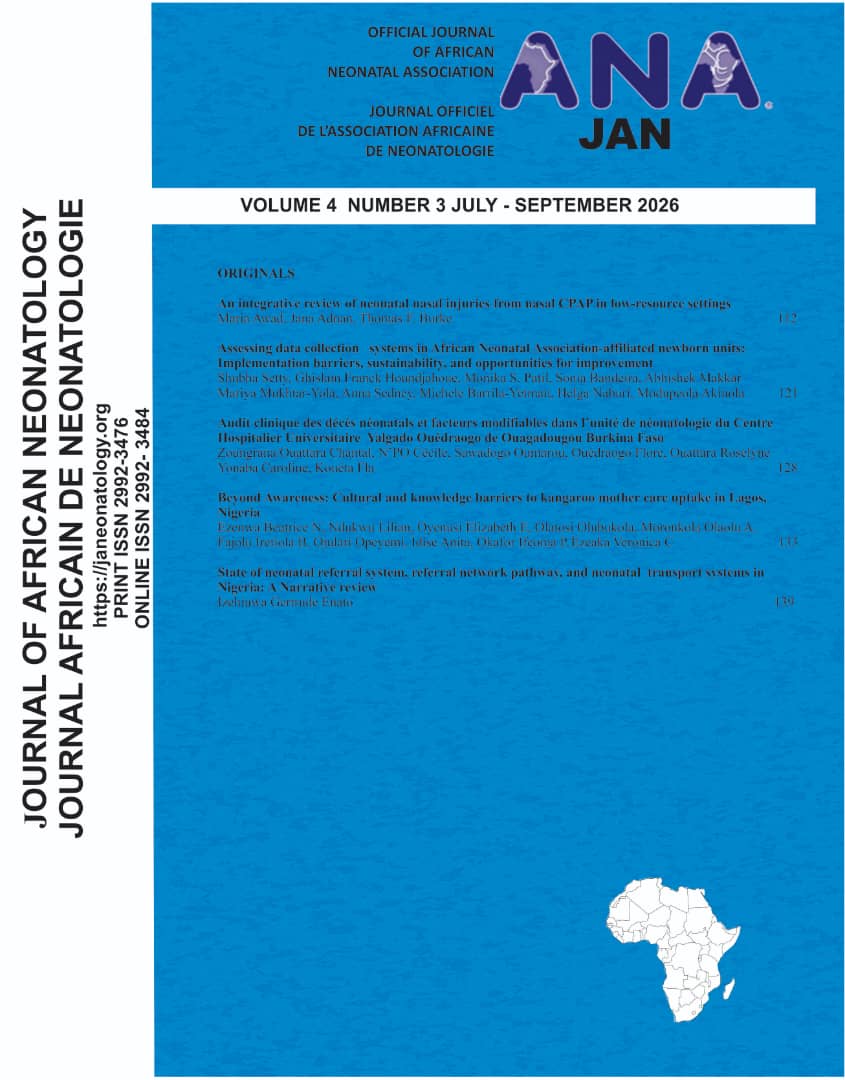
Assessing data collection systems in African Neonatal Association-affiliated newborn units: Implementation barriers, sustainability, and opportunities for improvement
Keywords:
Data collection, Quality Improvement, Newborns/NeonatesAbstract
Globally, the under-five mortality rate has decreased, though reductions in newborn mortality have not improved to the same degree. Data collection systems have been widely shown in the literature to improve newborn care and subsequently mortality outcomes, often through facilitating quality improvement (QI) initiatives. The African Neonatal Association (ANA) has partnered with the Children's Hospitals Neonatal Consortium (CHNC) to support their mission of improving outcomes for newborns and their families in Africa through the development of an Africa-focused data network. To support this initiative, a survey was disseminated to ANA-affiliated newborn care facilities to establish a baseline assessment of newborn-specific data systems, identify barriers and limitations, evaluate the use of databases for QI initiatives, and assess educational needs. Survey respondents identified that despite high utilization of data collection systems for monitoring newborn outcomes and QI initiatives, key barriers to sustainability and effectiveness of these databases included insufficient staffing, inadequate funding, and high clinical workloads. There is ongoing collaborative development of a virtual QI workshop between CHNC and ANA members to support newborn healthcare providers in LMIC settings, given unanimous QI education interest from survey respondents.
References
Gu D, Zheng X, Zhou Y, Tan F, Gui R, Wei L, et al. Neonatal mortality trends in the 21st century: findings from the Global Burden of Disease Study 2021. J Pediatr (Rio J). 2026.102(2):101519. doi:10.1016/j.jped.2026.101519.
2. United Nations Inter-Agency Group for Child Mortality Estimation (UN IGME). Levels and trends in child mortality: report 2025 [Internet]. New York: UNICEF; 2025. Available from: https://data.unicef.org/resources/levels-and-trends-in-child-mortality-2025/. Accessed August 29, 2024.
3. Paulson KR, Kamath AM, Alam T, Bienhoff K, Abady GG, Abbas J, et al. Global, regional, and national progress towards Sustainable Development Goal 3.2 for neonatal and child health: all-cause and cause-specific mortality findings from the Global Burden of Disease Study 2019. The Lancet. 2021. 398(10303):870-905. doi: 10.1016/s0140-6736(21)01207-1
4. World Health Organization. Standards for improving quality of care for small and sick newborns in health facilities [Internet]. Geneva: World Health Organization; 2020. Available from: https:// iris.who.int/handle/10665/334213. Accessed September 10, 2024.
5. Kruk ME, Gage AD, Arsenault C, Jordan K, Leslie HH, Roder-DeWan S, et al. High-quality health systems in the Sustainable Development Goals era: time for a revolution. Lancet Glob Health. 2018;6 (11):e1196-252. doi: 10.1016/S2214-109X(18)30386-3.
6. Saboth PK, Sarin E, Alwadhi V, Jaiswal A, Mohanty JS, Choudhary N, et al. Addressing Quality of Care in Pediatric Units using a Digital Tool: Implementation Experience from 18 SNCU of India. J Trop Pediatr. 2021;67(1):1-11. doi: 10.1093/tropej/fmab005.
7 Deorari A, Mehta R, Livesley N. Improving the Quality of Care for Mothers and Newborns in Health Facilities: Point of Care Quality Improvement. New Delhi, India: World Health Organization, Regional Office for South-East Asia; 2017.
8. Shetu HB, Aragaw FM, Negash WD, Belachew TB, Asmamaw DB, Tareke AA, et al. Assessing postnatal care for newborns in Sub-Saharan Africa: A multinational analysis. PLoS One. 2024;19(2):1-15. doi: 10.1371/journal.pone.0298459.
9. Ayele BA, Holliday E, Hassen TA, Chojenta C. Maternal and neonatal health service access and utilization in sub-Saharan Africa (2015–2023): a systematic review and metaanalysis. BMC Health Serv Res 2026. 26(1):1-14. doi: 10.1186/s12913-026-14611-1.
10. Choi J, Urubuto F, Dusabimana R, Agaba F, Teteli R, Kumwami M, et al. Establishing a neonatal database in a tertiary hospital in Rwanda—an observational study. Paediatr Int Child Health. 2019;39(4):265-274. doi:10.1080/20469047.2019.160705 6. Epub 2019 May 13. PMID: 31079590.
11. Ntigurirwa P, Mellor K, Langer D, Evans M, Robertson E, Tuyisenge L, et al. A health partnership to reduce neonatal mortality in four hospitals in Rwanda. Global Health. 2017;13(1):28. doi: 10.1186/s12992-017-0252-6. PMID: 28569202; PMCID: PMC5452413.
12. Gumede-Moyo S, Todd J, Bond V, Mee P, Filteau S. A qualitative inquiry into implementing an electronic health record system (SmartCare) for prevention of mother-to-child transmission data in Zambia: a retrospective study. BMJ Open. 2019;9(9):e030428. doi:10.1136/bmjopen-2019-030428. PMID: 31494616; PMCID: PMC6731929.
13. African Neonatal Association. African Neonatal Association [Internet]. Available from: https://africanneonatal.org/. Accessed September 10, 2024.
14. African Neonatal Association. ANA partners with VON to form African Neonatal Network (ANN) [Internet]. 2023. Available from: https://africanneonatal.org/anapartners-with-von-to-form-a-nn/. Accessed September 10, 2024.
15. Children’s Hospitals Neonatal Consortium. Children’s Hospitals Neonatal Consortium (CHNC) [Internet]. Dover (DE): Children’s Hospitals Neonatal Consortium; Available from: https://www.thechnc.org/. Accessed September 10, 2024.
16. Mariani I, Abathun F, Mouhamadou O, Minja J, Kananura RM, Tognon F, et al. Organizational and management factors and related endusers' perspectives relevant to newborn and stillbirth data at different levels of the health system: findings of the IMPULSE study in Uganda, Ethiopia, Tanzania, and the Central African Republic. J Glob Health. 2025;15:04329. doi: 10.7189/jogh.15.04329.
17. World Health Organization. Improving maternal and newborn health and survival and reducing stillbirth: progress report 2023 [Internet]. Geneva: World Health Organization; 2023 [cited 2026 Jul 24]. License: CC BY-NC-SA 3.0 IGO. Available from: https://www.who.int/publications/i/item/9789240073655. Accessed February 19, 2025.
18. Cross JH, Bohne C, Ngwala SK, Shabani J, Wainaina J, Dosunmu O, et al. Neonatal inpatient dataset for small and sick newborn care in low- and middle-income countries: systematic development and multi-country operationalisation with NEST360. BMC Pediatr. 2023;23(Suppl 2):567. doi: 10.1186/s12887-023-04341-2.
19. World Health Organization. Global strategy on digital health 2020–2025 [Internet]. Geneva: World Health Organization; 2021. Available from: https://iris.who.int/server/api/core/bitstreams/1f4d4a08-b20d-4c36-9148-a59429ac3477/content. Accessed February 15, 2025.
20. Aqil A, Lippeveld T, Hozumi D. PRISM framework: a paradigm shift for designing, strengthening, and evaluating routine health information systems. Health Policy Plan. 2009;24(3):217-228. doi:10.1093/heapol/czp010
Downloads
Published
Issue
Section
License
Copyright (c) 2026 JOURNAL OF AFRICAN NEONATOLOGY

This work is licensed under a Creative Commons Attribution-NonCommercial-ShareAlike 4.0 International License.
This is an open-access journal, and articles are distributed under the terms of the Creative Commons Attribution-NonCommercial-ShareAlike 4.0 License, which allows others to remix, tweak, and build upon the work non-commercially, as long as appropriate credit is given and the new creations are licensed under the identical terms.